

Poo-tee-weet?
Kurt Vonnegut Saw This Coming A Mile Away

Hello, reader.
If you’ve been reading the news lately and feeling like you’re trapped in a malfunctioning simulation designed by the alter-ego Kilgore Trout, you’re right: Kurt Vonnegut has been writing about our current situation throughout his whole career.
Listen. The man who survived the firebombing of Dresden and responded by writing about blue aliens with plungers for hands didn’t just write “science fiction” (a designation which he hated). He wrote survival manuals for the absurdity of modern life.
If Kurt were alive today in 2026, I don’t think that he would be surprised by how we turned out. I think he’d just be confused that we let our one earth go to shit and that the real-life version of his developmentally-disabled protagonist from the book Slapstick, Wilbur Daffodil-11 Swain, was actually elected president.
And sure, he’d be super pissed off that he would need Meta Verification just to tell us “I told you so.” But hey, that’s capitalism, baby.
So it goes.
In the various novels and short stories from his prolific career, Vonnegut predicted a past, present, and future (unstuck in time, really) that featured numbskull authoritarians, the horrors of war, and the dehumanizing effect of technology.
So the ghost of Vonnegut is currently haunting our current reality. Hope you have an entire pack of Pall Malls, because you’re going to need it.
We don’t need the government to interrupt our minds, because we’ve let the tech corporations co-op our train of thought
First, in Vonnegut’s 1961 short story “Harrison Bergeron,” the author warns how the government will achieve “perfect equality” by physically and sometimes mentally handicapping anyone who is too smart, fast, or beautiful.
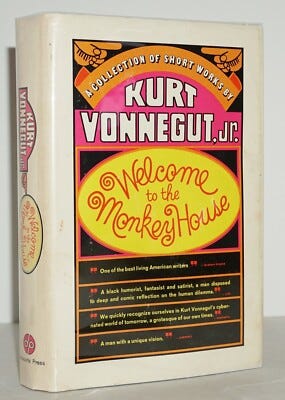
Fast forward to today, where we’ve achieved a different kind of Bergeron-esque equilibrium. Instead of mental handicap radios in our ears, we have social media’s infinite scroll algorithms. We don’t need the government to interrupt our minds, because we’ve let the tech corporations co-op our train of thought. We’ve voluntarily strapped black mirrors in front of our faces that ensure no one can maintain a coherent train of thought for longer than a TikTok dance.
Kurt would also say this is the “Golden Age of the Granfalloon.”
In Cat’s Cradle, Vonnegut introduced the Granfalloon: a proud and meaningless association of people. This can be Hoosiers, political parties, or people who make “being a Scorpio” their entire personality.
These groups are totally artificial and completely meaningless. Turns out you’ll be no better a person because you now call yourself a Christian or recently identify as a Flat Earther (even if you are just trying to troll the educated elites). You were a dumb asshole then and you are still a dumbasshole now, despite whatever “club” you currently belong to.
And the internet age has only made this worse. Local dummies who used to find themselves isolated from the world can now find kindred spirits (and subscribers!) on a dozen different virtual platforms. We have sorted ourselves into modern tribes based on political cults, corporate fandoms, or allegiance to billionaires and brands, and it’s only made us more isolated.
As Kurt warned, these groups give society a sense of belonging while having the intellectual depth of a birdbath.
And did somebody say fascism? In 2026? Yes, Vonnegut warned us about the dangers of Nazis living in our ranks, and no book does it better than Mother Night (1961).
If you are unfamiliar with the novel, it is about an American playwright named Howard W. Campbell, Jr. who moonlights as a high-level propagandist for the Nazi party. Turns out he was also a spy for the United States, but the lines of good and evil have been blurred so many times that Campbell struggles to know who he truly is.
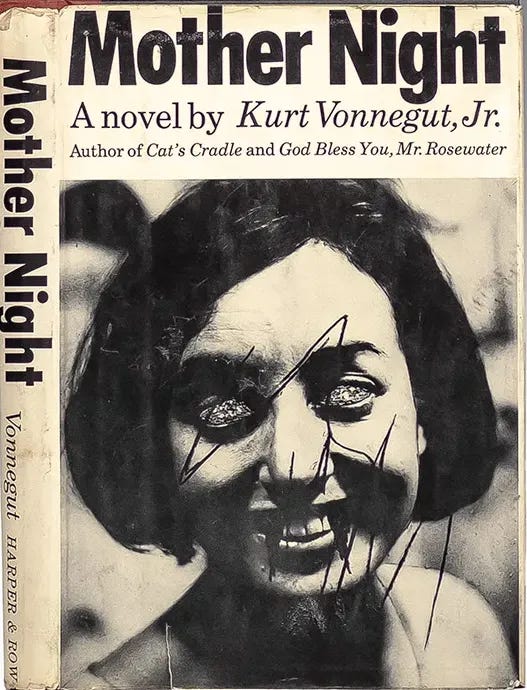
Vonnegut always knew that America was full of National Socialist-apologists, and I don’t think he would be mildly surprised to learn that a lot of them are actually running the country.
Remember when David Duke, former Grand Wizard of the Ku Klux Klan, actually endorsed Donald Trump for president? Southern Republicans, not wanting to “treason their heritage,” didn’t even bat an eye. Remember, his reelection was according to Duke, “a victory for our people.”
If Mother Night taught us anything it’s that “We are what we pretend to be, so we must be careful about what we pretend to be.”
Do I think there are members of his cabinet that are white supremacists? Yes (see Pete Hegseth). Do I think that President Donald Trump is a secret Nazi or member of the Klan? No. But even pretending to be, even just to cater to the white supremacist vote, is a dangerous proposition. If Mother Night taught us anything it’s that “We are what we pretend to be, so we must be careful about what we pretend to be.”
And finally, we must go back to Vonnegut’s first book Player Piano, originally published in 1952, to examine where we currently are in relation to modern technological advances in Artificial Intelligence.
Player Piano is a cautionary tale, fraught with psychological tension as the author explores a society where the "technological elite" manages machines that have rendered the vast majority of human labor obsolete.
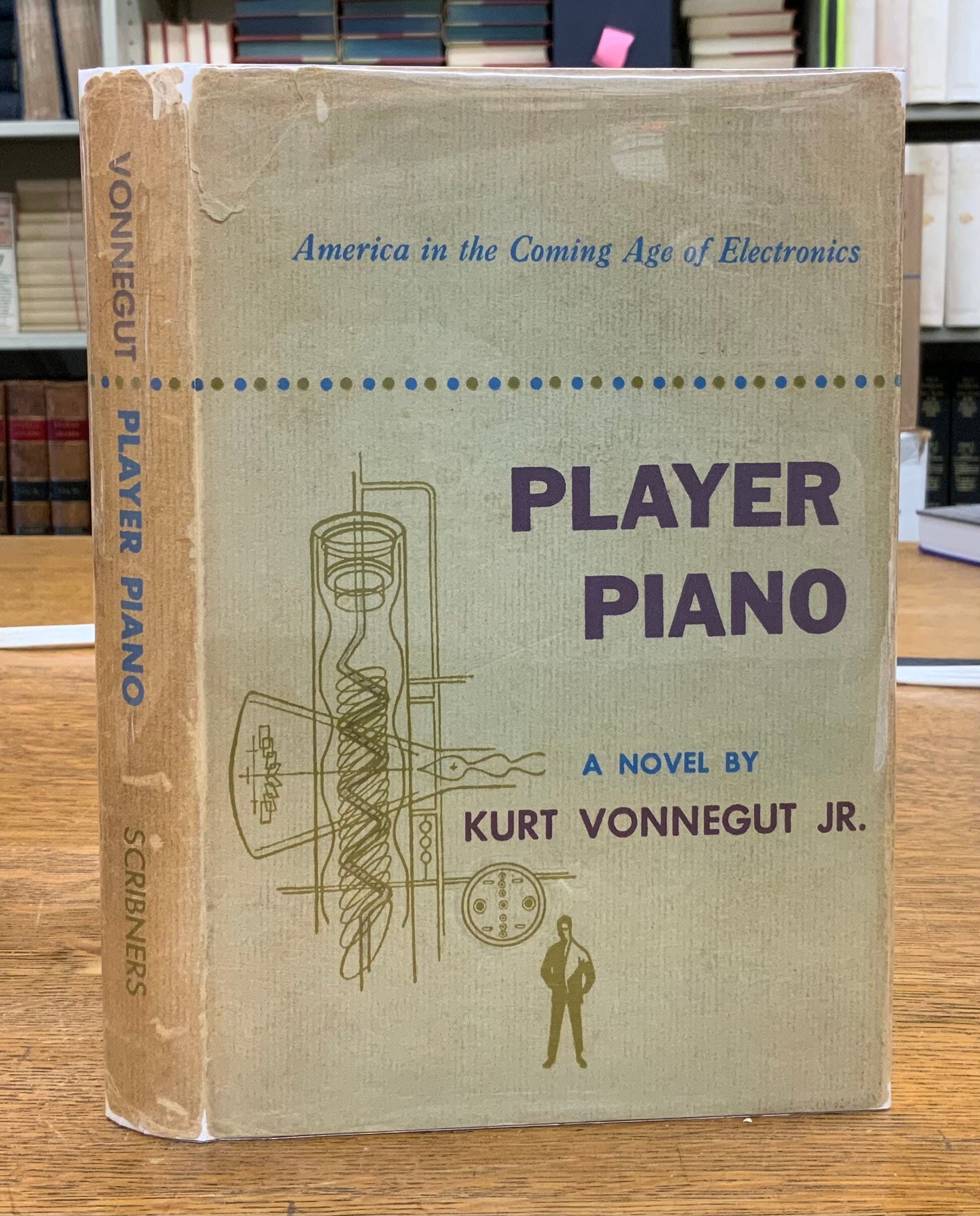
Yet while most science fiction authors of the 1950s focused on robots replacing factory workers, Vonnegut foresaw that technology would eventually replace white-collar, administrative, and creative jobs.
Vonnegut believed that humans, despite their creativity and intelligence, are DEFINITELY replaceable. And now the rise of Artificial Intelligence and Large Language Models has moved beyond physical automation to intellectual automation, affecting professions like law, finance, and journalism.
And even the technology sector itself isn’t safe. We just saw Jack Dorsey’s fintech company Block lay off 4,000 workers due to his newfound love of AI. “Intelligence tools have changed what it means to build and run a company,” Dorsey told investors. “A significantly smaller team, using the tools we’re building, can do more and do it better.”
The most ominous line in Dorsey’s letter came toward the end: “Within the next year,” he wrote, “I believe the majority of companies will reach the same conclusion and make similar structural changes.”
The central theme of Player Piano is that when machines take over the core tasks of production, humanity faces a crisis of meaning, not just unemployment. As AI takes on more complex tasks, humans are increasingly grappling with a sense of obsolescence, asking what, if anything, is left for humans to do.
Society then becomes a “player piano,” essentially running itself without real human intervention. It has become heavily dependent on algorithms, smart devices, and automated decision-making often without understanding how they work or what the future fallout will be.
So it goes?
Yes, Vonnegut’s books have always been about humanity’s deep despair and a struggle for meaning, however, his books also feature characters that are capable of performing profound acts of kindness. He knew that humans are “great big meat-machines” who are remarkably bad at being rational but occasionally very good at being nice.
As a humanist, Vonnegut himself believed that there are still people out there trying to do the right thing without expectations of rewards or punishments in an afterlife. Most of his books often emphasize compassion, reason, and human responsibility, for better or for worse.
I don’t think any of his novels really sum up his belief in the potential of mankind better than his book God Bless You, Mr. Rosewater:
“Hello, babies. Welcome to Earth. It’s hot in the summer and cold in the winter. It’s round and wet and crowded. At the outside, babies, you’ve got about a hundred years here. There’s only one rule that I know of, babies—God damn it, you’ve got to be kind.“
So if we are living in one of Kilgore Trout’s science fiction dystopias or one of Vonnegut’s satirical black comedies, I hope it’s one where people at least try to behave decently at least.
We can hope right?
Poo-tee-weet?